id: 4335117
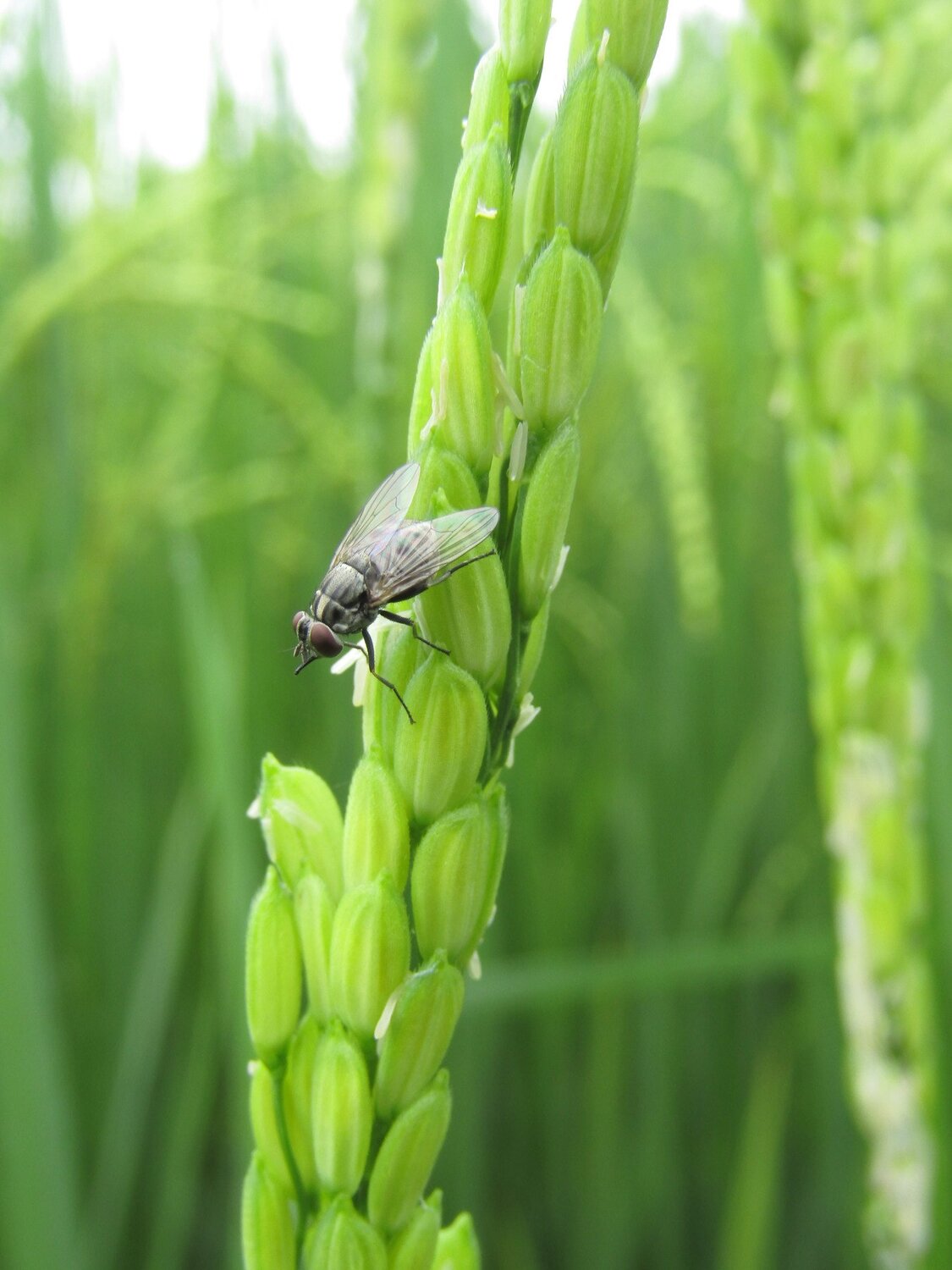
The housefly (Musca domestica) is a fly of the suborder Cyclorrhapha. It is believed to have evolved in the Cenozoic era, possibly in the Middle East, and has spread all over the world as a commensal of humans. It is the most common fly species found in houses. Adults are grey to black, with four dark, longitudinal lines on the thorax, slightly hairy bodies, and a single pair of membranous wings. They have red eyes, set farther apart in the slightly larger female.
Kingdom:
Animalia
Phylum:
Arthropoda
Class:Insecta
Order:Diptera
Section:Schizophora
Family:Muscidae
Genus:Musca
Species:M. domestica
The female housefly usually mates only once and stores the sperm for later use. She lays batches of about 100 eggs on decaying organic matter such as food waste, carrion, or feces. These soon hatch into legless white larvae, known as maggots. After 2 to 5 days of development, these metamorphose into reddish-brown pupae, about 8 mm (0.3 in) long. Adult flies normally live for 2 to 4 weeks, but can hibernate during the winter. The adults feed on a variety of liquid or semiliquid substances, as well as solid materials which have been softened by their saliva. They can carry pathogens on their bodies and in their faeces, contaminate food, and contribute to the transfer of food-borne illnesses, while, in numbers, they can be physically annoying. For these reasons, they are considered pests.
Houseflies have been used in the laboratory in research into aging and sex determination. Flies appear in literature from Ancient Greek myth and Aesop's The Impertinent Insect onwards. Authors sometimes choose the fly to speak of the brevity of life, as in William Blake's 1794 poem "The Fly", which deals with mortality subject to uncontrollable circumstances.
Flies are a nuisance, disturbing people at leisure and at work, but they are disliked principally because of their habits of contaminating foodstuffs. They alternate between breeding and feeding in dirty places with feeding on human foods, during which process they soften the food with saliva and deposit their feces, creating a health hazard.[38] However, fly larvae are as nutritious as fish meal, and could be used to convert waste to feed for fish and livestock.[39] Housefly larvae have been used in traditional cures since the Ming period in China (1386 AD) for a range of medical conditions and have been considered as a useful source of chitosan, with antioxidant properties, and possibly other proteins and polysaccharides of medical value.[
Housefly stay not only house.it lives such like slums and paddy field
0 Likes
0 Favorites
275 Impressions
0 Comments