id: 2365166
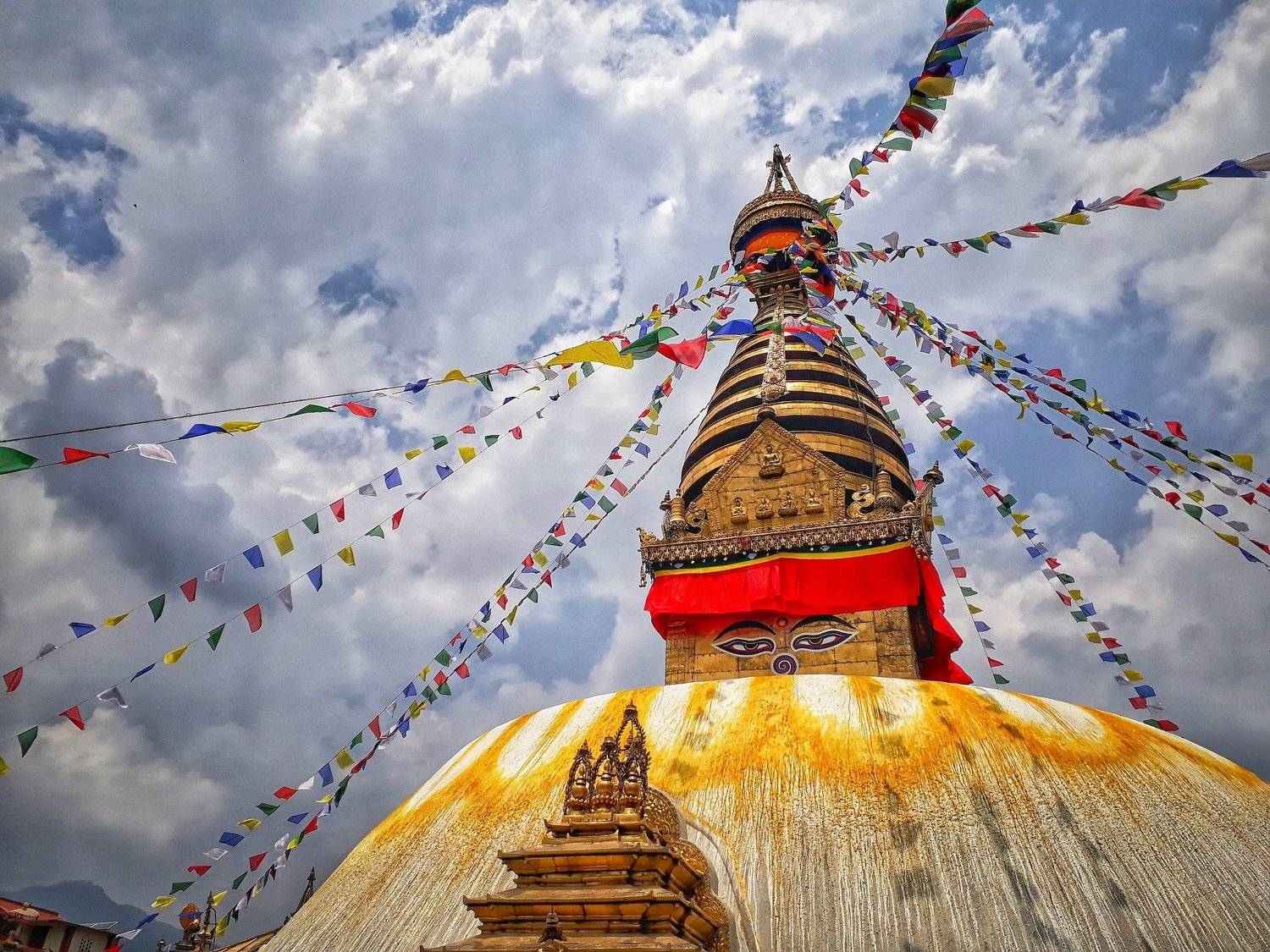
Inside my trip in Nepal. My friend bring me SwoyambhuNath Stupa people also calling monkey tempal.
Local people saying about this Stupa and history .
Mythology
According to Swayambhu Purana, the entire valley was once filled with an enormous lake, out of which grew a lotus. The valley came to be known as Swayambhu, meaning "Self-Created." The name comes from an eternal self-existent flame (svyaṃbhu) over which a sūpa was later built.
Swayambhunath is also known as the Monkey Temple as there are holy monkeys living in the north-west parts of the temple. They are holy because Manjushri, the bodhisattva of wisdom and learning was raising the hill which the stupa stands on. He was supposed to leave his hair short but he made it grow long and head lice grew. It is said that the head lice transformed into these monkeys.
Manjusri had a vision of the Lotus at Swayambhu and traveled there to worship it. Seeing that the valley can be a good settlement and to make the site more accessible to human pilgrims, he cut a gorge at Chovar. The water drained out of the lake, leaving the valley in which Kathmandu now lies. The Lotus was transformed into a hill and the flower became the stupa.
History
Swayambhunath is among the oldest religious sites in Nepal. According to the Gopālarājavaṃśāvalī, it was founded by the great-grandfather of King Mānadeva (464-505 CE), King Vṛsadeva, about the beginning of the 5th century CE. This seems to be confirmed by a damaged stone inscription found at the site, which indicates that King Mānadeva ordered work done in 640 CE.
However, Emperor Ashoka is said to have visited the site in the third century BCE and built a temple on the hill which was later destroyed.
Although the site is considered Buddhist, the place is revered by both Buddhists and Hindus. Numerous Hindu monarch followers are known to have paid their homage to the temple, including Pratap Malla, the powerful king of Kathmandu, who is responsible for the construction of the eastern stairway in the 17th century.
The stupa was completely renovated in May 2010, its first major renovation since 1921 and its 15th in the nearly 1,500 years since it was built. The dome was re-gilded using 20 kg of gold. The renovation was funded by the Tibetan Nyingma Meditation Center of California, and began in June 2008.
At around 5 a.m. on 14 February 2011, Pratapur Temple in the Swayambhu Monument Zone suffered damage from a lightning strike during a sudden thunderstorm.
The Swayambunath complex suffered damage in the April 2015 Nepal earthquake.
Architecture
The stupa consists of a dome at the base, above which is a cubical structure painted with eyes of Buddha looking in all four directions. There are pentagonal Toran present above each of the four sides with statues engraved in them. Behind and above the Torana there are thirteen tiers. Above all the tiers there is a small space above which the Gajur is present. The stupa has many artifacts inside it.
Symbolism
The dome at the base represents the entire world. When a person awakes (represented by eyes of wisdom and compassion) from the bonds of the world, the person reaches the state of enlightenment. The thirteen pinnacles on the top symbolize that sentient beings have to go through the thirteen stages of spiritual realizations to reach enlightenment or Buddhahood.
There is a large pair of eyes on each of the four sides of the main stupa which represent Wisdom and Compassion. Above each pair of eyes is another eye, the third eye. It is said that when Buddha preaches, cosmic rays emanate from the third eye which acts as messages to heavenly beings so that those interested can come down to earth to listen to the Buddha. The hellish beings and beings below the human realm cannot come to earth to listen to the Buddha's teaching, however, the cosmic rays relieve their suffering when Buddha preaches. Between the two eyes (also called Wisdom Eyes), a curly symbol, symbolizing the nose, is depicted which looks like a question mark, which is a Nepali sign of number figure one. This sign represents the unity of all things existing in the world as well as the only path to enlightenment through the teachings of Buddha.
There are carvings of the Panch Buddhas (five Buddhas) on each of the four sides of the stupa. There are also statues of the Buddhas at the base of the stupas. Panch Buddhas are Buddha in a metaphorical sense in Tantrayana. They are Vairochana (occupies the center and is the master of the temple), Akshobhya (faces the east and represents the cosmic element of consciousness), Ratna Sambhava (faces the south and represents the cosmic element of sensation), Amitabha (He represents cosmic element of Sanjna (name) and always faces the West) and Amoghsiddhi (He represents the cosmic element of confirmation and faces the north).
Each morning before dawn hundreds of Buddhist (Vajrayana) and Hindu pilgrims ascend the steps from the eastern side that lead up the hill, passing the gilded Vajra (Tibetan: Dorje) and two lions guarding the entrance, and begin a series of clockwise circumambulations of the stupa.
0 Likes
1 Favorites
237 Impressions
0 Comments