id: 2342819
Pahela Baishakh (Bengali: পহেলা বৈশাখ) or Bangla Nababarsha (Bengali: বাংলা নববর্ষ, Bangla Nôbobôrsho) is the first day of Bengali Calendar. It is celebrated on 14 April as a national holiday in Bangladesh, and on 14 or 15 April in the Indian states of West Bengal, Tripura and part of Assam by people of Bengali heritage, irrespective of their religious faith.[5]
The festival date is set according to the lunisolar Bengali calendar as the first day of its first month Baishakh.[6] It therefore almost always falls on or about 14 April every year on the Gregorian calendar.[6] The same day is observed elsewhere as the traditional solar new year and a harvest festival by Hindus and Sikhs, and is known by other names such as Vaisakhi in central and north India, Vishu in Kerala and Puthandu in Tamil Nadu.[2][3][4]
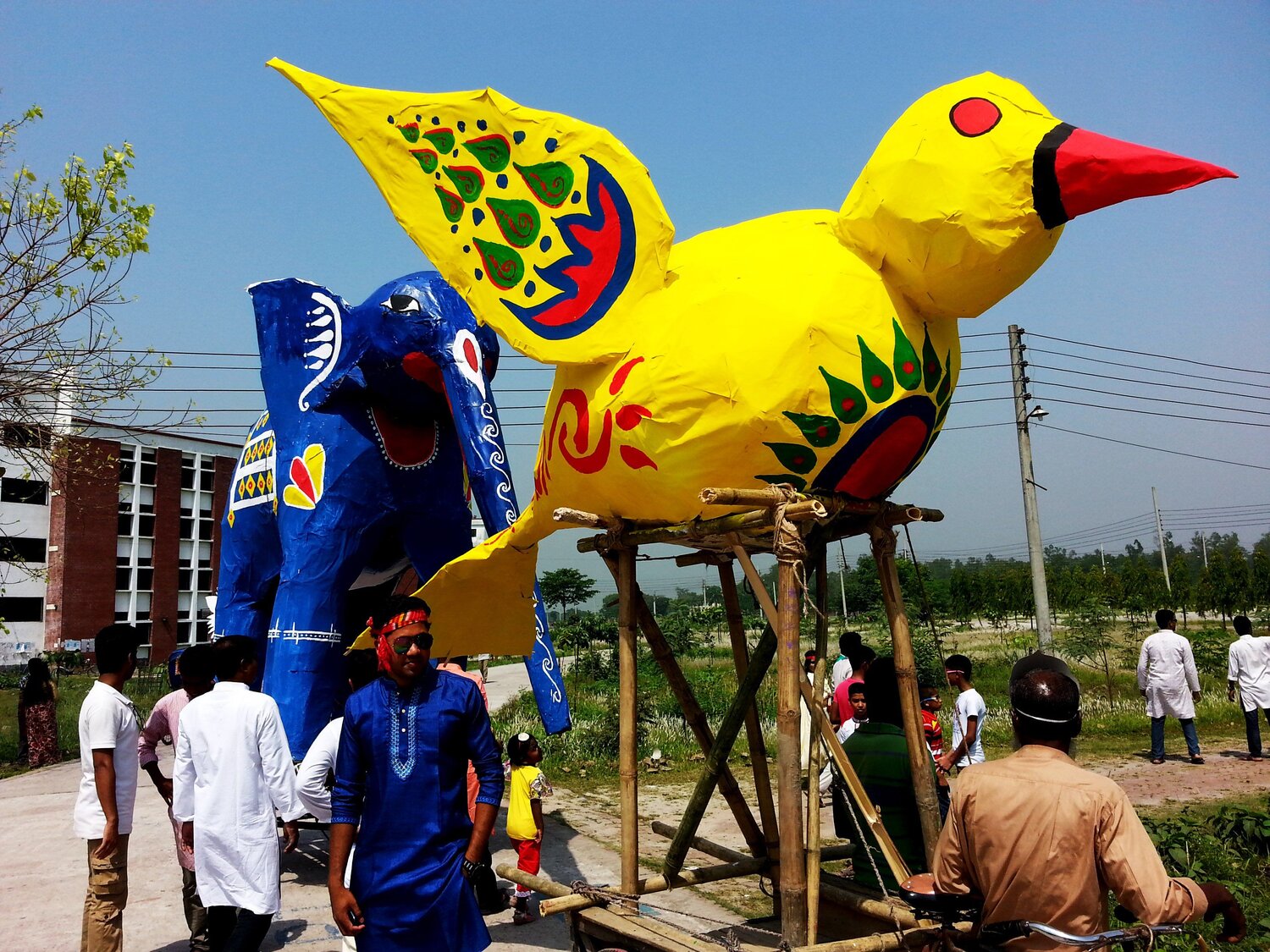
The festival is celebrated with processions, fairs and family time. The traditional greeting for Bengali New Year is শুভ নববর্ষ "Shubho Nabobarsho" which is literally "Happy New Year". The festive Mangal Shobhajatra is organized in Bangladesh. In 2016, the UNESCO declared this festivity organized by the Dhaka University as a cultural heritage of humanity.[7]
Mughal origins theory
During the Mughal rule, land taxes were collected from Bengali people according to the Islamic Hijri calendar. This calendar was a lunar calendar, and its new year did not coincide with the solar agricultural cycles. According to some sources, the festival was a tradition introduced in Bengal during the rule of Mughal Emperor Akbar to time the tax year to the harvest, and the Bangla year was therewith called Bangabda. Akbar asked the royal astronomer Fathullah Shirazi to create a new calendar by combining the lunar Islamic calendar and solar Hindu calendar already in use, and this was known as Fasholi shan (harvest calendar). According to some historians, this started the Bengali calendar.[8][9] According to Shamsuzzaman Khan, it could be Nawab Murshid Quli Khan, a Mughal governor, who first used the tradition of Punyaho as "a day for ceremonial land tax collection", and used Akbar's fiscal policy to start the Bangla calendar.[10]
According to Shamsuzzaman Khan,[10] and Nitish Sengupta, the origin of the Bengali calendar is unclear.[11] According to Shamsuzzaman, "it is called Bangla san or saal, which are Arabic and Parsee words respectively, suggests that it was introduced by a Muslim king or sultan."[10] In contrast, according to Sengupta, its traditional name is Bangabda.[11][12]
Some historians attribute the Bengali calendar to the 7th century king Shashanka.[10][11] The term Bangabda (Bangla year) is found too in two Shiva temples many centuries older than Akbar era, suggesting that Bengali calendar existed before Akbar's time.[11] It is also unclear, whether it was adopted by Hussain Shah or Akbar. The tradition to use the Bengali calendar may have been started by Hussain Shah before Akbar.[11] Regardless of who adopted the Bengali calendar and the new year, states Sengupta, it helped collect land taxes after the spring harvest based on traditional Bengali calendar, because the Islamic Hijri calendar created administrative difficulties in setting the collection date.[11]
0 Likes
0 Favorites
240 Impressions
0 Comments