id: 13370704
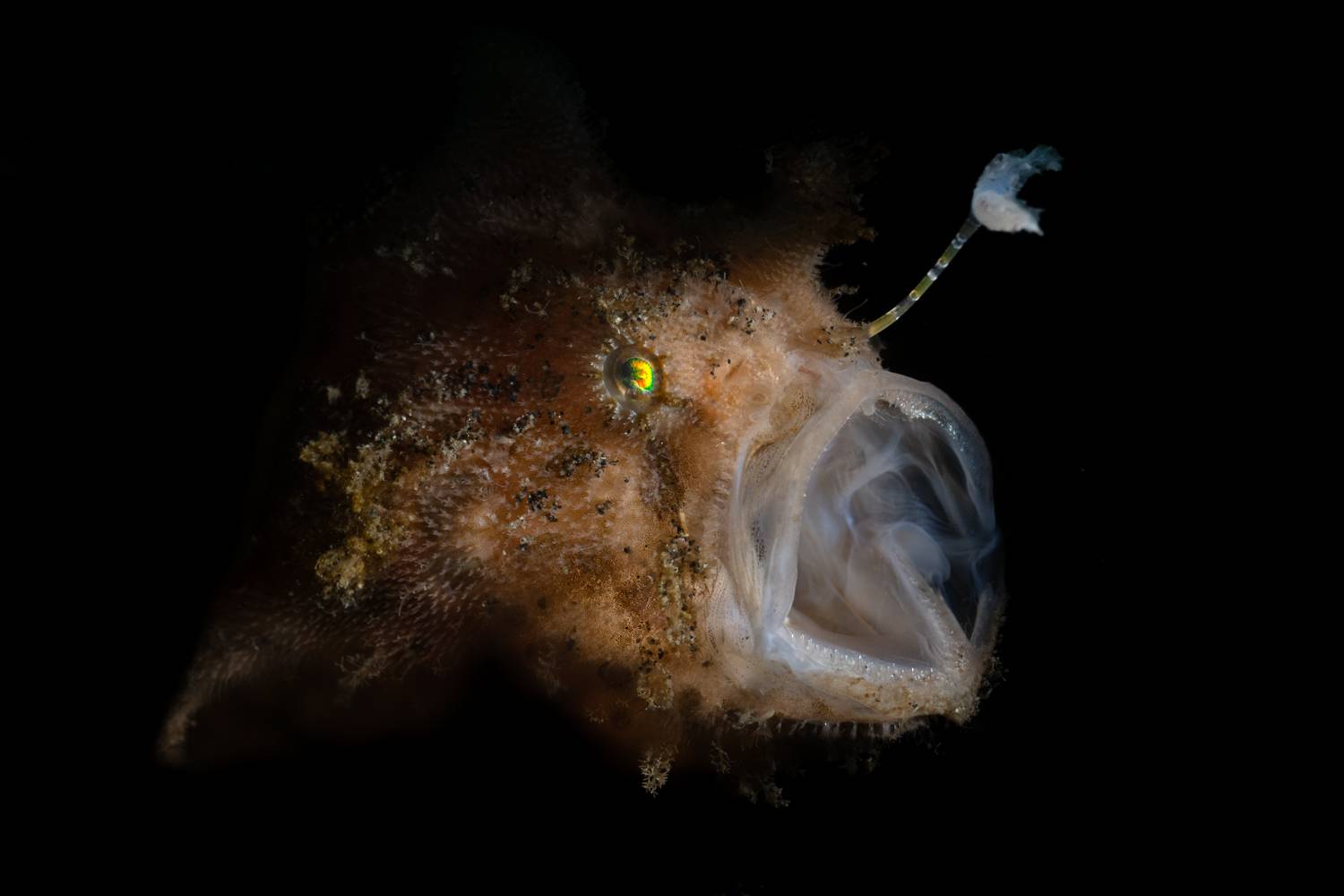
This image shows a frogfish from the family Antennariidae photographed in the muck habitats of Indonesia’s Lembeh Strait. The photo captures a rare moment in which the frogfish simultaneously opens its mouth wide and deploys its illicium—the modified dorsal spine that functions as a fishing lure. Using a precisely positioned snoot and a fast shutter speed, I aimed to freeze both the dramatic jaw expansion and the delicate, elongated lure as it extended forward into the water column. The narrow beam isolates these behaviors against the dark volcanic substrate, emphasizing the complex anatomy involved in a frogfish strike.
This photograph is meaningful because it documents two key predatory behaviors occurring at once: the rapid expansion of the buccal cavity and the activation of the lure (esca). Frogfish are specialized ambush predators, capable of drawing prey into their mouths in as little as six milliseconds. By wiggling the lure like a small worm or shrimp, they entice unsuspecting prey closer before executing their lightning-fast strike. Seeing the lure deployed clearly in combination with an open-mouth display is uncommon, as both events are brief and difficult to anticipate.
The behavior observed during this encounter was characteristic of a hunting adult. The frogfish remained nearly motionless on the substrate, relying on camouflage while subtly flicking the lure to attract potential prey. I approached slowly and remained stationary for long periods, allowing the frogfish to ignore my presence and resume natural predatory movements. Over two dives, I watched for any sign of lure activity and waited for the fish to open its mouth spontaneously—a behavior that may indicate a strike attempt, a threat display, or a yawn. The photograph was taken without disturbing the animal, documenting a fleeting combination of behaviors that reveal the extraordinary adaptations of one of the ocean’s most efficient ambush predators.
0 Likes
2 Favorites
770 Impressions
0 Comments