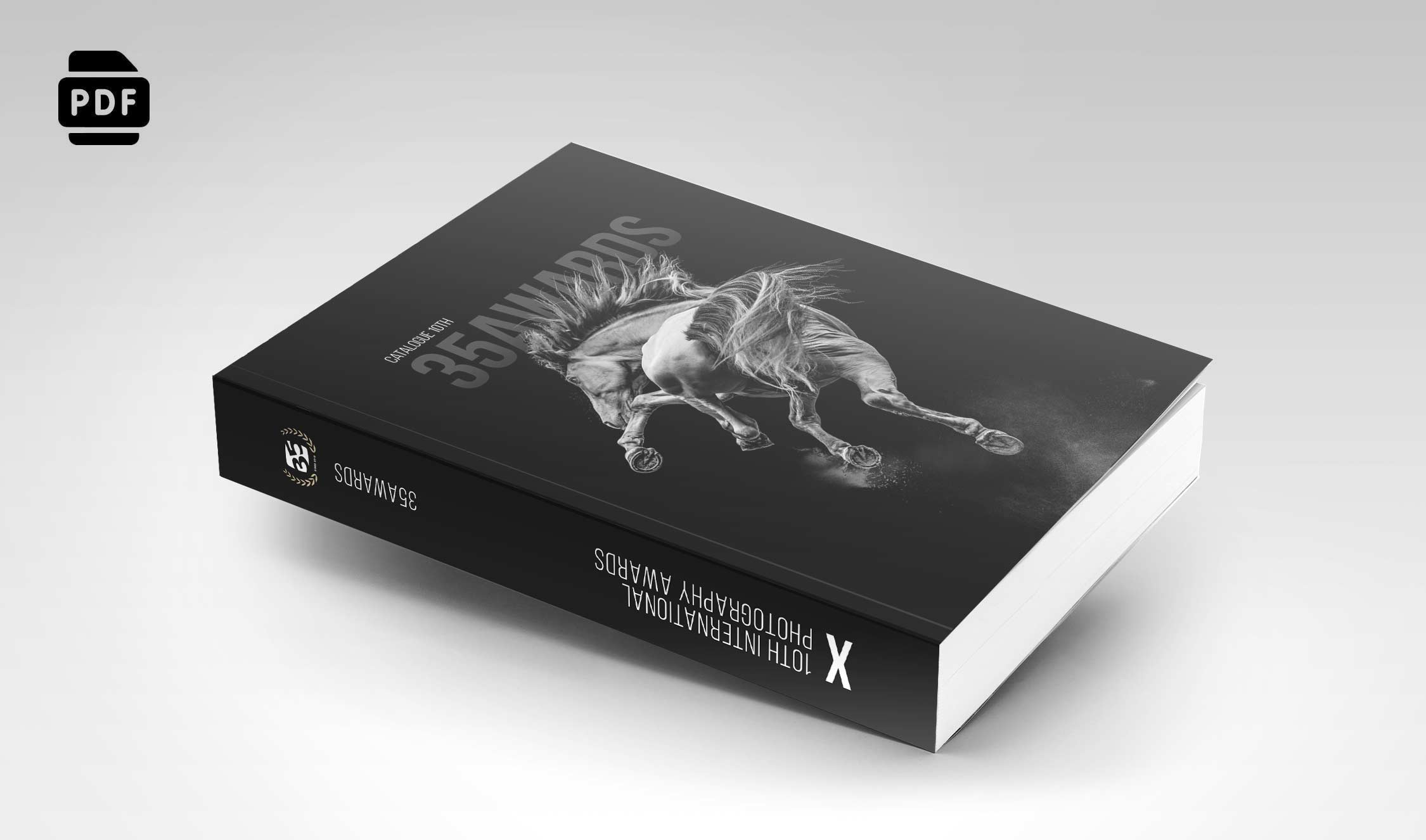
CATALOGUE 10TH 35AWARDS
BEST PHOTOS AND PHOTOGRAPHERS
The catalog contains more than 1500 photos from 25 nominations from more than 1000 authors of the 10th 35AWARDS
35AWARDS uses a multi-stage selection system. Photos pass through several voting stages, and the group of evaluators changes as the contest moves closer to the final.
This approach makes it possible to compare a large number of works first, then pass the strongest photos to the professional photographic community and the jury. During voting, the photo author is hidden: the work is evaluated, not the photographer’s name.
A large number of photographs are submitted to 35AWARDS. It is not possible to send every work directly to the final jury, so the contest is organized as a sequential selection process.
At each next stage, fewer photos remain and the level of selection becomes stricter. The system gradually moves from mass comparison to professional evaluation of the best photographs.
Passing a stage is already a result for a photo, but it does not automatically mean reaching the TOP 100 or becoming a winner.
How 35AWARDS results are calculated →Stage 1 has to process a very large number of photos, so it uses mass voting and anonymous pairwise comparison within a nomination.
Registered users and viewers can take part. The goal is to identify photos that perform strongly relative to other entries.
According to existing public explanations, on average about ten percent of the best works in a category automatically advance to Stage 2, but the exact threshold is not fixed and depends on competition level.
At the next stage, the 35PHOTO professional photography community joins the evaluation of the strongest works. Votes from the professional community have priority weight.
Regular viewers and participants may also continue voting at this stage, and some works can advance through strong audience support or verified scores.
The international jury may also review works between stages and manually move strong photos forward if they could have been missed in mass voting.
The strongest works reach the 35AWARDS jury. The jury consists of professional photographers from different countries and works with photos that have passed the previous stages.
At Stage 3, jury members rate photos on a 5-point scale and select the best works in nominations. Registered participants may also vote using the 5-point system alongside the experts.
The final stage is involved in determining nomination winners, catalogue participants and final rankings.
During voting, information about the author is hidden. A voter evaluates the work without knowing who made it, which country the author is from, or what results they had in previous contests.
This helps prevent reputation, follower count and personal connections from becoming additional factors in photo evaluation. After results are published, authorship becomes available in the usual way.
Photos should not receive an advantage only because they were uploaded earlier or shown more often to the same people.
The system distributes photos among voters to collect enough independent scores and provide comparable conditions for works.
The internal distribution algorithm is not published because it takes contest and stage parameters into account.
The first scores for a photo are based on a small number of votes and may change noticeably. As more comparisons are collected, the result becomes more stable.
A few early high scores do not mean that the photo will necessarily keep the same position after hundreds of later comparisons.
The current score during the contest is a reference point, not the final result.
According to the main contest rules, an author cannot vote for their own works. It is also possible to vote for the same work only once within one voting stage.
This restriction is needed so that the result of a photo is formed by other participants’ evaluations, not by the author’s own actions.
In contests with open online voting, attempts to artificially influence results must be taken into account. 35AWARDS analyzes voting and may detect suspicious activity that differs from normal participant behavior.
When evaluating results, signs of anomalous voting and other data may be used to detect attempts to manipulate outcomes. Suspicious votes or results may be reviewed additionally when necessary.
The details of protection mechanisms are not published so that they are harder to bypass.
If the system or moderators detect suspicious activity, the situation may be reviewed additionally. Depending on the violation, votes, a photo result or a user’s participation may be revised.
Specific measures are determined by contest rules and the circumstances of the case.
35AWARDS Rules →If a participant believes a photo violates contest rules, they can report it to the organizers using the tools available on the site. In the voting interface, photos have a report button for possible rule violations.
A report by itself does not mean automatic removal. First, it must be checked whether the work actually violates the contest rules.
The review may consider the photo itself, the nomination, contest-specific requirements, information from the author and other data needed for verification.
Yes. If a photo violates contest rules, organizers may remove it from participation. The reason may be a mismatch with nomination requirements or another rule violation.
The fact that a photo has already received many votes or passed one of the stages does not cancel the requirement to follow contest rules.
With a large number of works, it is impossible to guarantee manual review of every photo by all criteria before voting begins, so some violations are found later: automatically, by moderators, after reports or during additional review.
Before the contest is complete, a participant may see a preliminary score for their photos. It helps understand audience reaction and compare submitted works, but it is not the final 35AWARDS result.
Main voting begins separately, and the contest result is formed after the required selection stages. A photo with a high preliminary score is therefore not guaranteed a place in the final, and its position may change after later voting stages.
The final result is determined by voting and selection at the stages set for the contest. Author data is hidden during anonymous voting to reduce the influence of external factors.
Photo evaluation is always subjective to some degree. Different photographers and jury members may have different taste, experience and views of what makes a strong photograph.
The goal of the multi-stage system is not to produce one “correct” opinion, but to collect many independent evaluations and gradually identify works that receive the strongest support at different selection stages.
For this reason, one participant’s disagreement with a specific result does not by itself mean that voting was incorrect.
Share on social networks:
35AWARDS 2026
35PHOTO Professional Photo Community
© Kochergin Valery