id: 5325150
Attending theyyam is by far the best thing one can do while they are in Kerala.
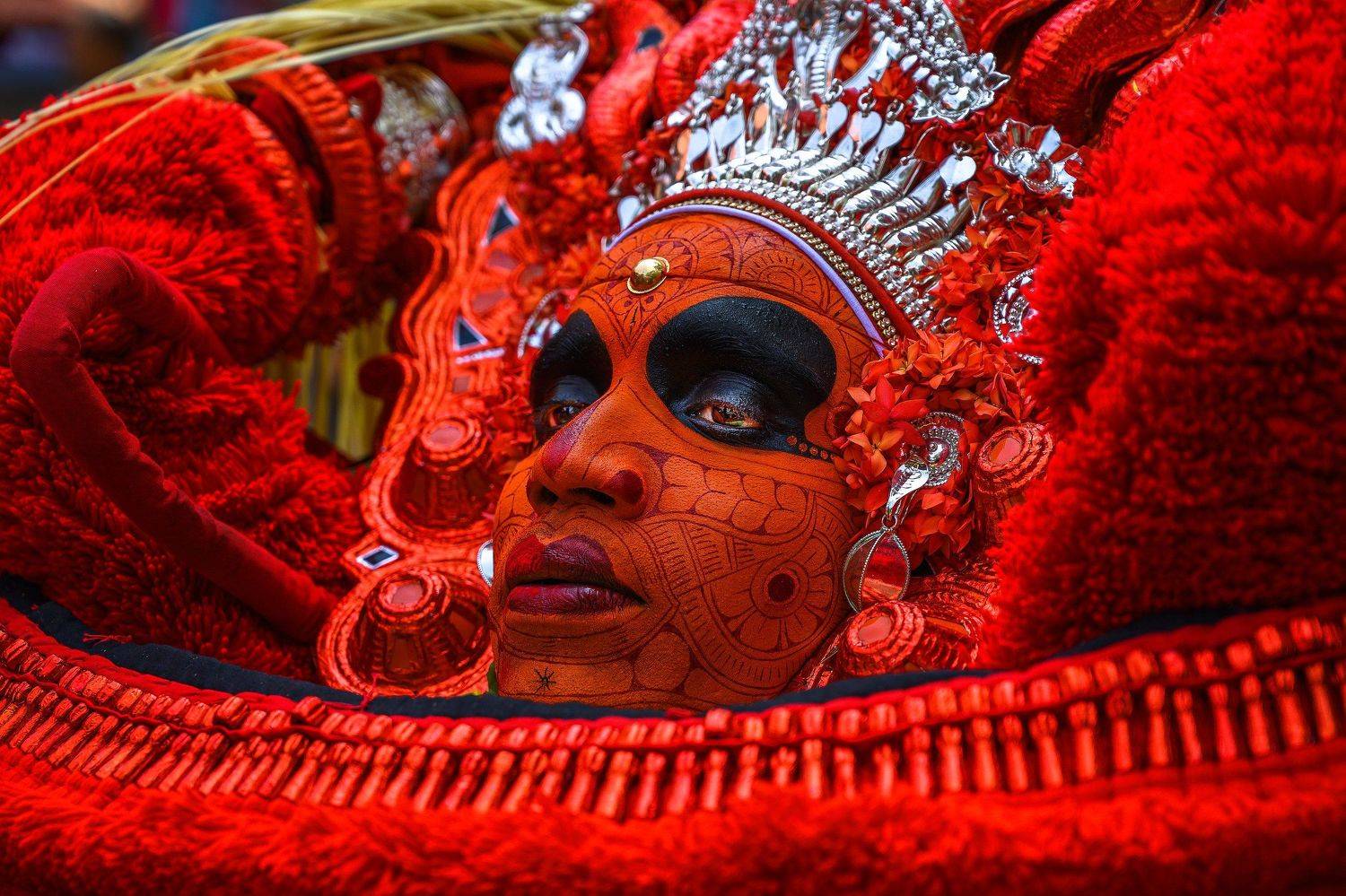
”Theyyam” is a ritualistic performance, which can be described as the most visible, spectacular art
form of Malabar (Northern part of Kerala), associated with myths and legends. Theyyam can also be
described as a form of worship consisting of rituals, colorful costumes and divine dance through
which the gods are appeased and honoured. Theyyam – the form of worshipping gods, goddesses,
legendary heroes etc is based on a rather simple concept, that after suitable propitiatory rituals, the
god or goddess belonging to a temple becomes temporally manifest in the body of an empowered
man (the performer), thereby elevating him to a divine status. Theyyam ceremonies usually take
place either within the precincts of a small shrine – usually called Kavu, Kazhakam, Muchilottu,
Mundiya, Sthanametc or in the yard of an ancestral house, or in an open space with a temporary
shrine called Pathi.
According to Hinduism, all the creation-preservation-destruction activities in the universe are
controlled by the three Gods – Brahma, Vishnu, and Maheshwara (Shiva), respectively. For
upholding righteousness, these gods appears in many godly guises and incarnations. For propitiation
of these gods, apart from ritualistic worship and sacrifices, man also gave form to donning their
godly forms and performing as another form of worship. These became a part of their culture,
underwent many changes over time, and is an evolution of the clan culture. It is very difficult to find
out the exact period of the origin of theyyam. At the same time none can refute its antiquity.
According to the general belief the origin of the theyyam is attributed to ManakkadanGurukkal.(
Gurukkal means master) He was a great artist and occultist belonging to the Vannan Community.
Once, the Rajah of Chirakkal invited this great occultist to test his capacity as an artist as well as a
magician. Gurukkal was residing at Manakkad in Karivellur, about 40 kilometers away from the
palace of the Rajah. The Rajah had given several tests like causing obstacles to the ferry as he was
trying to cross the river. But Gurukkal managed to cross the river with his divine power. The gates of
the fort were also closed to prevent him from entering, but here also he managed to appear before
the king with his physical power. The Rajah sat along with a few other persons so that Gurukkal
could not identify him. But Gurukkal easily recognized the king and respected. While he was called
for the food it was so arranged that he himself would have to throw away the plantain leaf in which
food would be supplied. This was intended to make him feel inferior. Gurukkal foreseeing this
received the hot rice in a melon leaf and after taking the food he swallowed the leaf and thus he
cleverly avoided the indignity of himself taking the leaf and throwing it away. Thus he successfully
overcame the tests of the Raja, Manakkadan. Gurukkal was asked to make the costumes for some
deities whose ritualistic dances were to be performed in the form of the theyyams in the night.
Accordingly, Gurukkal designed 35 different theyyams before the sunrise. Rajah realizing Gurukkal’s
skill, a title, Manakkadan was bestowed on Gurukkal. It is believed that this is how the present form
of Theyyams originated.
Theyyam reveals the human capabilities of abstraction, synthesis, and idealization; it describes social
and economic activities and reveals practices, beliefs and ideas. It provides a unique insight into
spirituality, intellectual life and cultural adventures. It is a divine dance with ancient testimony of
customs, traditions and artistic creativity. Shrines, ancestral houses, Kavus in villages offer the
platform for theyyam festivals. Since the theyyam performer, transforms to the status of a particular
deity, theyyam is very much a divine dance. Invoking god or goddess in his body, he dances through
the compound of the sacred space where deities are worshipped. The dance is considered not for
propitiating gods or goddesses, rather it is dance of the gods or goddesses themselves. Scores of
nature deities (including animals and trees), ancestors, village heroes and heroines, and gods and
goddesses from Saivite, Vaisnavite and Sakti traditions of Hinduism form part of the pantheon of
theyyam performance. The fundamental facts of existence of theyyam performance, even in the
present day, make the ritual a powerful instrument that influences the thoughts and practices of
Malabar society. In support of this, experts point out that the deities are worshipped and propitiated
for the blessing of fertility, for protection and security. There are powerful deities who ward off
smallpox and other contagious diseases. Theyyam ritual performances also provide judicial services.
Some of the major disputes and caste conflicts are often settled by a specific representative of a
particular deity during the theyyam performance. The devotees present their personal problems and
troubles to the deities and the deities give them counsel and blessings.
During the time when I attended one of these rituals in theyyam, I was positioned right in front of
where the holy bonfire is made in order to click photographs. I was warned by the authorities there
to sit somewhere else as the devotee who dances in and around the fire strews the embers in his
enthusiasm and that it was dangerous for me. I was quite reluctant to move, because I had travelled
far to reach there and really wanted to materialise the composition that I had in my mind. I decided
to stay put and watch the performance.
As the performer entered the premises, the energy of the area completely changed. Their dance
form was extremely exhilarating to watch and they were performing with absolutely no holding
back. As he entered the fire , dancing to the music, his movements and actions actually tossed a
large amount of embers in his surroundings and especially on me because I was in proximity. I got
really promising photos but I got burned by the shower of embers and my clothes got badly burnt
too albeit at the compensation of getting some really memorable photographs.
0 Лайки
0 В избранном
39 Показы
0 Комментарии