id: 12950891
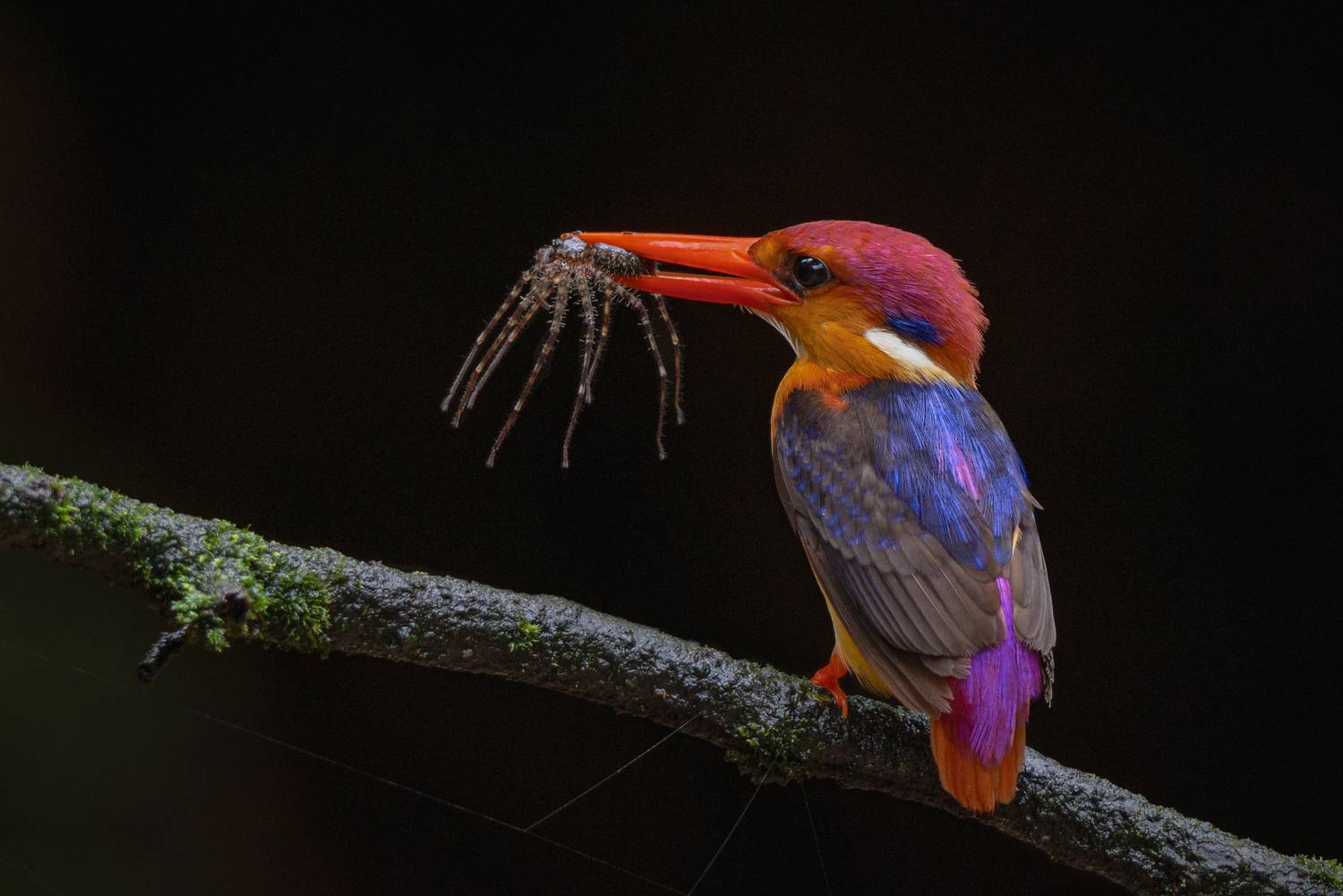
During my fieldwork in the Indian Western Ghats, I focused on documenting the feeding behavior of the Oriental Dwarf Kingfisher (Ceyx erithaca) during its active nesting phase. Beyond visual documentation, the aim was to understand how prey selection reflects ecological conditions, resource availability, and the shared responsibility of parent birds.
Initial observations were successfully recorded on the first day. However, in search of a more nuanced behavioral moment and a naturally distinct background, I explored an alternative nesting site suggested by my local field guide. The location was remote, reachable only by a demanding foot trail through steep terrain, with forecasts indicating prolonged heavy rainfall.
Despite the conditions, the journey continued the following morning.
After walking nearly four kilometers through dense forest under persistent rain and limited visibility, we reached the site and established a discreet, non-intrusive setup. Time stretched quietly in the rainforest. Then, in a fleeting and irreplaceable moment, one of the parent kingfishers arrived carrying an unusually large prey — a spider — a rarely documented subject in such clear detail for this species.
The bird paused for only a few seconds. In that narrow window, every technical and instinctive decision had to align instantly. The resulting image captures not just predator and prey, but also a faint spider web beneath the catch — a delicate detail that subtly reflects the intricate balance of life within the rainforest.
This photograph is not merely an image, but the outcome of perseverance, ethical field practice, and deep respect for the natural process. In wildlife photography, moments are not repeated — they are earned.
0 Likes
5 Favorites
751 Impressions
0 Comments